In May 2026, Anthropic shipped "Dreaming" for Claude Code: automated nightly memory consolidation. Your agent wakes up each morning having pruned stale entries, merged duplicates, and resolved contradictions. I've been running nightly consolidation in my personal agent harness since March. Not "I told you so." Here's what they haven't built yet.
Dreaming solves one problem well. But it's one layer of a five-layer system. Skip any layer and the compounding stops. Your agent stays useful for weeks, maybe months. Then it starts forgetting. Users complain. You add hacks. Architecture debt piles up. Every agent harness builder will eventually arrive at this full architecture. The question is whether you build it deliberately or discover it piece by piece as your power users hit the walls.
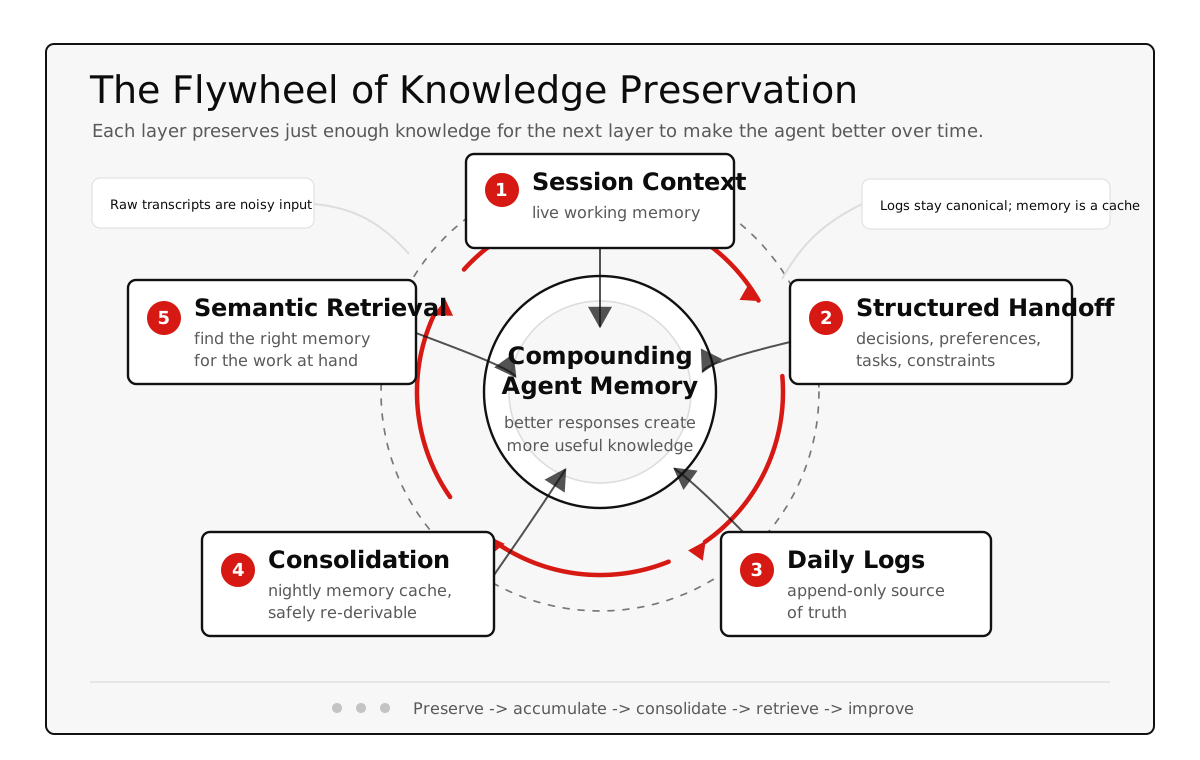
What Dreaming Gets Right
Anthropic's implementation does exactly what it should: takes a flat memory file, identifies redundancy and staleness, produces a cleaner version. No more "I remember you mentioned wanting to learn Rust" appearing three times with slight variations. No more entries from February about a project you abandoned in March.
Critical work. Without consolidation, memory files grow linearly with usage until they consume your context window. You either lose history or lose working space. Neither works.
But here's what the current implementation reveals: Dreaming consolidates from raw JSONL session transcripts into a 200-line memory file. No structured preservation layer. No semantic retrieval. Anthropic warns users to back up before enabling because aggressive pruning can lose things permanently.
That's not a bug. That's a missing architecture.
The Five Layers
Layer 1: Session Context
Your working memory. The live conversation. What the agent knows right now. Every chat interface has this.
Layer 2: Handoff / Session Bridge
Before a session ends, the agent writes structured notes about what happened and what matters for next time. Not a transcript. Not "user said X, I said Y." Structured extraction: decisions made, preferences revealed, tasks created, context for ongoing work.
Think of it as writing in your journal before falling asleep. You don't transcribe your entire day. You capture what's worth remembering.
This is the layer Dreaming skips. It consolidates directly from raw transcripts. Garbage in, garbage out.
Layer 3: Daily Logs / Accumulation
The journal itself. Append-only structured records. Every session's handoff gets logged with a timestamp. No loss, no pruning yet. This is your source of truth.
Cal (my harness) writes these as dated markdown files. Human-readable. Version-controlled. Grep-able. When something goes wrong, I can trace exactly what the agent knew and when.
Layer 4: Consolidation / Dreaming
Now you can consolidate safely. You're working from structured logs, not lossy transcripts. You can prune aggressively because nothing is actually lost; the daily logs remain intact underneath. The consolidated memory becomes a cache, not the canonical store.
This runs nightly in Cal. It looks back over the past week, identifies patterns, merges redundant information, and updates the active memory file. If it makes a mistake, I regenerate from logs. No data loss. No "back up before enabling."
Layer 5: Semantic Retrieval
A 200-line flat file works for a month. Maybe two. Then you hit the wall. Too much context has accumulated. The agent can't surface the right memory at the right time because everything is crammed into a linear document stuffed into every prompt.
Semantic retrieval solves this. Embed your knowledge base. When a session starts, retrieve the most relevant memories based on what the user is asking about. Vector search for meaning, keyword search for precision. Your effective memory becomes unbounded. The agent doesn't need to hold everything in context. It needs to know how to find what matters.
The Flywheel (And What Breaks Without It)
Here's why all five layers matter: they compound.
The more the harness knows about you, the better it responds. The better it responds, the more useful interactions you have. More useful interactions generate more knowledge. That knowledge needs to be preserved, accumulated, consolidated, and retrieved. Each layer feeds the next. The system gets smarter over time, not just within a session, but across months of use.
This is what separates a tool you use from a system that grows with you.
Remove Layer 2 (structured handoff): Your consolidation works from noisy transcripts. In April, I disabled handoff as an experiment and let consolidation work directly from raw session logs. Within a week, the memory started drifting. It remembered that I was working on a refactor but forgot why and what constraints I'd set. Context was lossy. Turned it back on.
Remove Layer 3 (daily logs): Your consolidation becomes destructive. Prune too aggressively and you lose data permanently with no way to recover. With append-only logs underneath, consolidation is safe. It's always re-derivable.
Remove Layer 5 (retrieval): You hit a hard cap. 200 lines. Maybe 500 if you're generous. My knowledge base is ~3,200 lines across three months of daily logs. When I start a session about authentication, Cal retrieves relevant memories from the past two months. When I switch to drafting a blog post, it retrieves different memories. The context adapts to the work. Without retrieval, you're forced to evict old knowledge to fit new knowledge. That's not memory. That's a notepad.
Why This Matters Now
Agent harnesses are moving from toys to infrastructure. People are running them daily. Businesses are deploying them. The bar for "good enough" is rising fast.
Dreaming is a signal that the industry sees the memory problem. But one layer out of five isn't enough. Power users don't want a tool that forgets. They want a system that compounds.
If you're building an agent harness, you will hit these walls. You can build the full stack now, or add layers reactively as users complain. I chose the former. Cal has been running the complete five-layer system since March 2026. Open source since May: github.com/monbishnoi/cal.
The code isn't perfect. The architecture is. And that's the flywheel: once it's spinning, it's hard to stop.
Ideas, views, and opinions are my own and do not represent those of any organization I am affiliated with.